
Hello, this is Linkgenesis 🙂
The term “AI” is no longer unfamiliar in manufacturing environments.
However, there remains a clear distinction between “implementing AI” and “AI actually running the factory.”
Linkgenesis encounters this gap daily on the factory floor.
Rather than focusing on technical explanations in this post,
we aim to discuss how AI perceives, judges, and executes tasks within a factory setting.
「 Linkgenesis’ Approach to Achieving the AI Factory 」
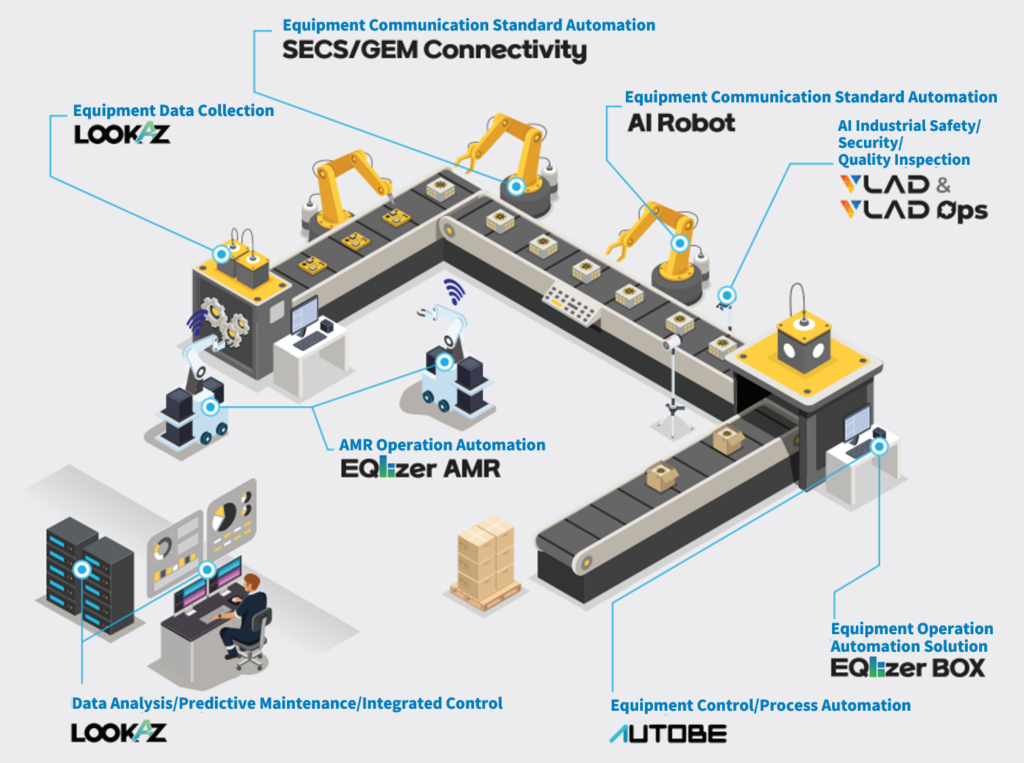
Over the past year, we have introduced technologies and use cases through individual posts focused on each solution, including SECS/GEM, EQlizer, VLAD & VLAD Ops, LOOKAZ, and AUTOBE.
However, when discussing the AI Factory,
it is now more important to consider “how these solutions connect”
rather than “what solutions are available.”
This is because an AI Factory is not built with a single technology or a single product.
「 The AI Factory follows a structure of ‘
Perception → Judgment → Execution’. 」
Linkgenesis defines the AI Factory
as three interconnected pillars:
Perception – Judgment – Automation.
When these three elements flow seamlessly together,
the factory can evolve beyond simple automation into a self-operating structure.
|
|
① The Domain of Perception: Unifying Factory Data
The starting point for an AI factory is connecting equipment and systems.
If data is scattered, AI cannot make judgments.
The SECS/GEM product suite reliably connects semiconductor/manufacturing equipment with higher-level systems,
enabling standardized communication of process data.
LOOKAZ visually recognizes and monitors equipment screens and operational status,
collecting and analyzing information previously observed by humans.
At this stage, the factory enters a state where
“previously invisible information begins to become visible.”

|
|

② The Realm of Judgment: Transforming Data into Meaning
Connected data must undergo analysis and judgment
before it can be utilized for operations.
VLAD & VLAD Ops understand process status and detect anomalies
through AI-based analysis and management functions from an operational perspective.
It goes beyond simple data visualization,
reconfiguring information around what decisions operators need to make.
At this stage, the factory advances
to a state where it can explain its own problems.
|
|
③ The Realm of Execution: Automating Judgment
The ultimate goal of an AI factory is execution.
No matter how good the analysis, if humans must manually intervene again, it has limitations.
EQlizer transitions equipment operation and process management—previously handled by humans—to automated control,
ensuring judgment outcomes immediately translate into on-site execution.
AUTOBE automates repetitive operational and management tasks,
enhancing overall operational efficiency, including non-process-related duties.
At this stage, the factory
establishes a structure that can operate autonomously, without human intervention.

「 Not a solution, but ‘a single AI factory structure’ 」
Linkgenesis solutions
function as independent products,
yet from an AI Factory perspective, they perform interconnected roles within a unified flow.
Perception: SECS/GEM · LOOKAZ
Judgment: VLAD & VLAD Ops
Execution: EQlizer · AUTOBE
This grouping
is less about “which solution to use”
and more about “how to design the factory.”
An AI Factory isn’t completed all at once.
An AI Factory
is not a project that changes everything at once,
but a structure completed step by step, tailored to the site.
Linkgenesis
respects existing equipment and legacy environments while
building AI Factories together in a way that realistically applies AI and automation.
If last year was about introducing solutions,
this year is about discussing the ‘structure and direction’ those solutions create.
The moment AI ceases to be merely technology
and begins operating in the language of the factory.
Linkgenesis’ AI Factory continues to evolve on the factory floor.
Thank you for visiting us today 🙂



One response to “AI Factory: It’s Not About Technology, It’s About Structure”
This piece is impressive and well-structured.
I find the entire site extremely helpful.