
Hello! This is Linkgenesis 🙂
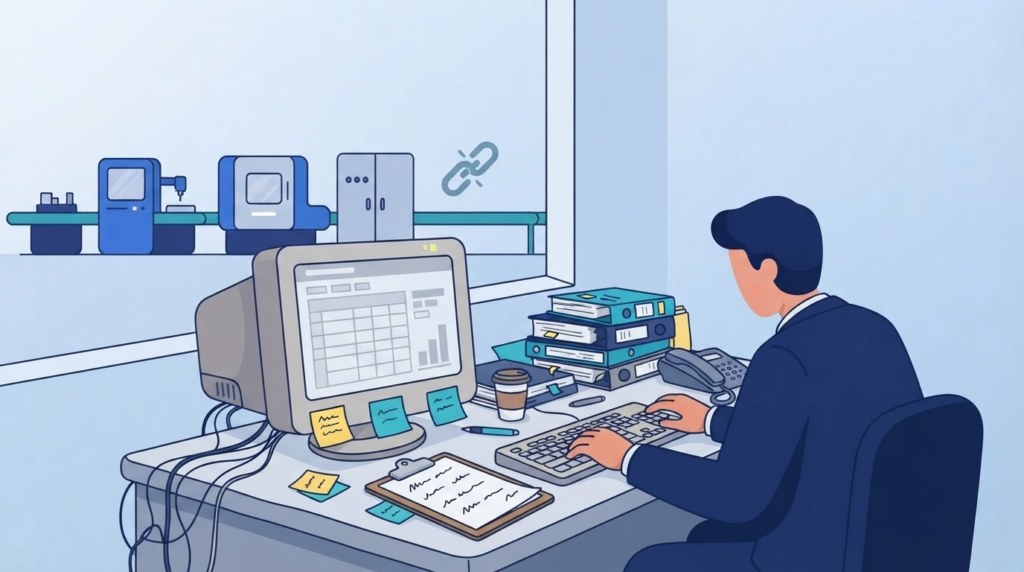
Anyone who has priced out an MES knows how the conversation usually goes.
The quote is larger than expected, the implementation window is long, and somewhere in the requirements review there is always a moment of “but our process doesn’t actually work that way.”
So a great many plants stay where they are — running production on spreadsheets and paper logs.
So, how high is that barrier really?
What the Data Says About Small and Mid-Sized Plants
Korea’s first official smart-manufacturing survey,
from the Ministry of SMEs and Startups and the Smart Manufacturing Innovation Task Force, put smart factory adoption at 19.5% overall and 18.6% among SMEs. Four plants in five have not started.
The single largest barrier cited was cost (47.1%), and among the plants that did adopt,
75.5% remain at a basic level of implementation. Manufacturing AI usage sits at 0.1% overall — essentially the starting line.
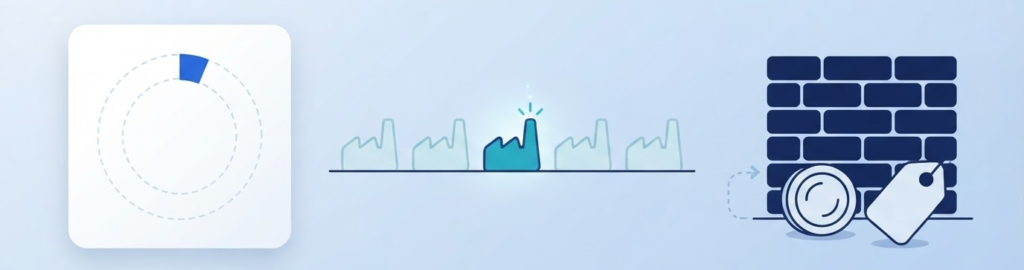
The results for plants that did cross that line, though, are hard to argue with.
Gyeongnam Province analyzed 439 manufacturers that adopted smart factories in 2022–2023 and reported productivity up 22.8%, quality up 44.3%, production cost down 32.5%,
and on-time delivery up 17.0%.
So the open question was never whether it works. It was whether a mid-sized plant can afford to start.
Where Is the MES Market Heading?
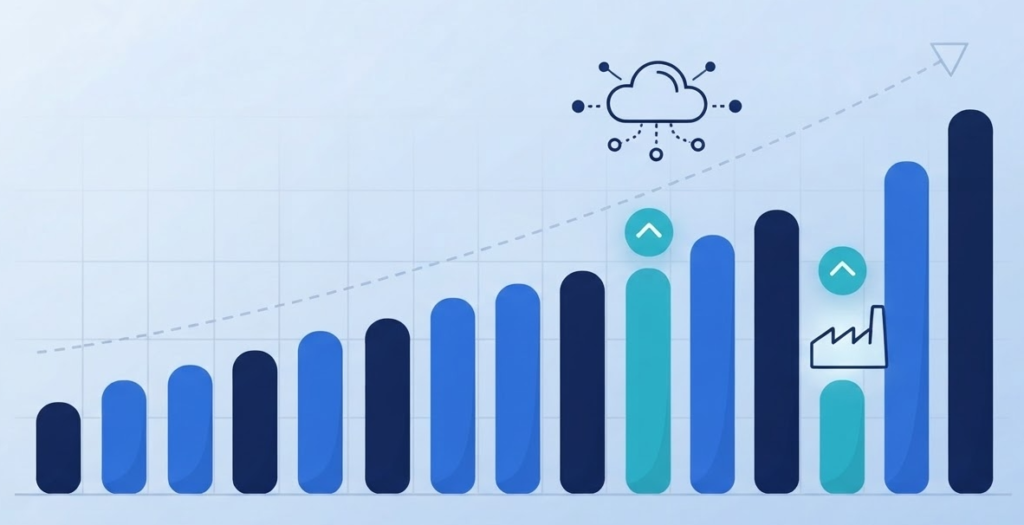
From roughly $14.5 billion in 2025 to about $44.7 billion by 2034, at a 13.3% CAGR.
The more interesting detail is who is driving that growth:
in North America, the SME segment is growing at 14.6% and cloud deployment at 15.2% — both faster than the market average.
MES, historically an enterprise purchase, is moving down-market.
So We Built LinkMES
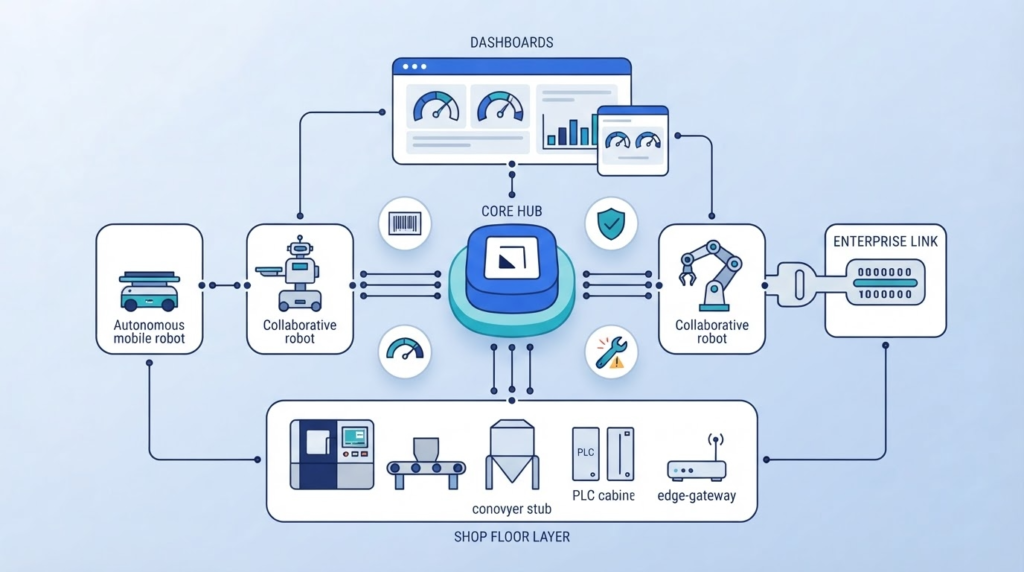
LinkMES is an enterprise-grade MES priced for small and mid-sized manufacturing — AI-driven process optimization and AMR/cobot integration included, with flexible change-point management as the lever that brings the deployment cost down.
- AI-ready by design
The data model assumes AI will be applied to it, rather than treating collection as the end goal. 4M traceability — material, machine, worker, process — runs on the same backbone as AI-based quality-anomaly and equipment-failure prediction. - Robot-friendly connectivity
AMRs, collaborative robots, and humanoid platforms connect as a mixed fleet, with automatic work-order issuance extending into AMR-based logistics automation. - No separate ERP required to begin
Order intake, production planning, and inventory live inside the MES itself, so a plant can move straight from spreadsheets to a system. If an external ERP comes later, it connects through standard interfaces rather than a rebuild. - Serious equipment monitoring and FDC
Real-time OEE via edge and PLC integration, automatic classification of downtime causes, and turnkey integrated FDC spanning multiple machines at once. Equipment control scales in stages — from simple control up to semiconductor-grade SECS/GEM standard-based precision control, which is the discipline our company has built its reputation on for two decades. - Change management without code
When a process or operating rule changes, it is a configuration change, not a redevelopment project. Legacy ERP, WMS, and POP systems connect over RESTful APIs.
Targets and Best-Fit Industries
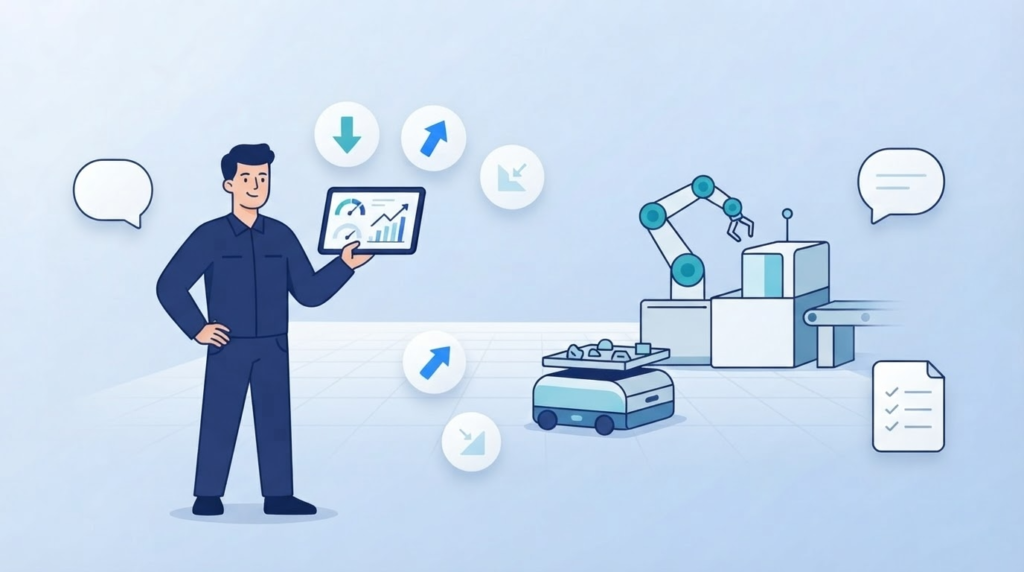
LinkMES targets to lower deployment cost and time, higher production efficiency, and a reduction in process defect rates.
The cost figure is our internal target, and we would rather show you pilot data for your own line than ask you to take it on faith.
Best fit:
- Robot-driven and automated processes
— AMR and cobot-based transfer and assembly. - Advanced assembly and machining
— electronics, automotive components, semiconductor and display, metal fabrication. - Process and batch industries
— chemicals, bio, food, cosmetics, where lot traceability and AI prediction are not optional. - Growing small and mid-sized manufacturers
— plants that cannot yet justify a separate ERP plus a dedicated monitoring system.
Implementation runs as on-site diagnosis and consulting, system design and custom configuration, pilot operation with robot integration testing, then full production and maintenance.
“The quote was out of reach, so we kept postponing it.”
“Our processes change faster than any system we’ve tried.”
If that is where you are, please reach out.
In the AI era, scale is no longer the gate — we can take on anything from connecting a single machine to integrating an entire plant.
On-site assessments and quotations are always welcome 🔍
Thank you for visiting our blog again today. Have a great day!
#MES #manufacturing execution system #smart factory #SME manufacturing #equipment monitoring #OEE #FDC predictive maintenance #AMR integration #SECS/GEM #LinkMES

Leave a Reply