
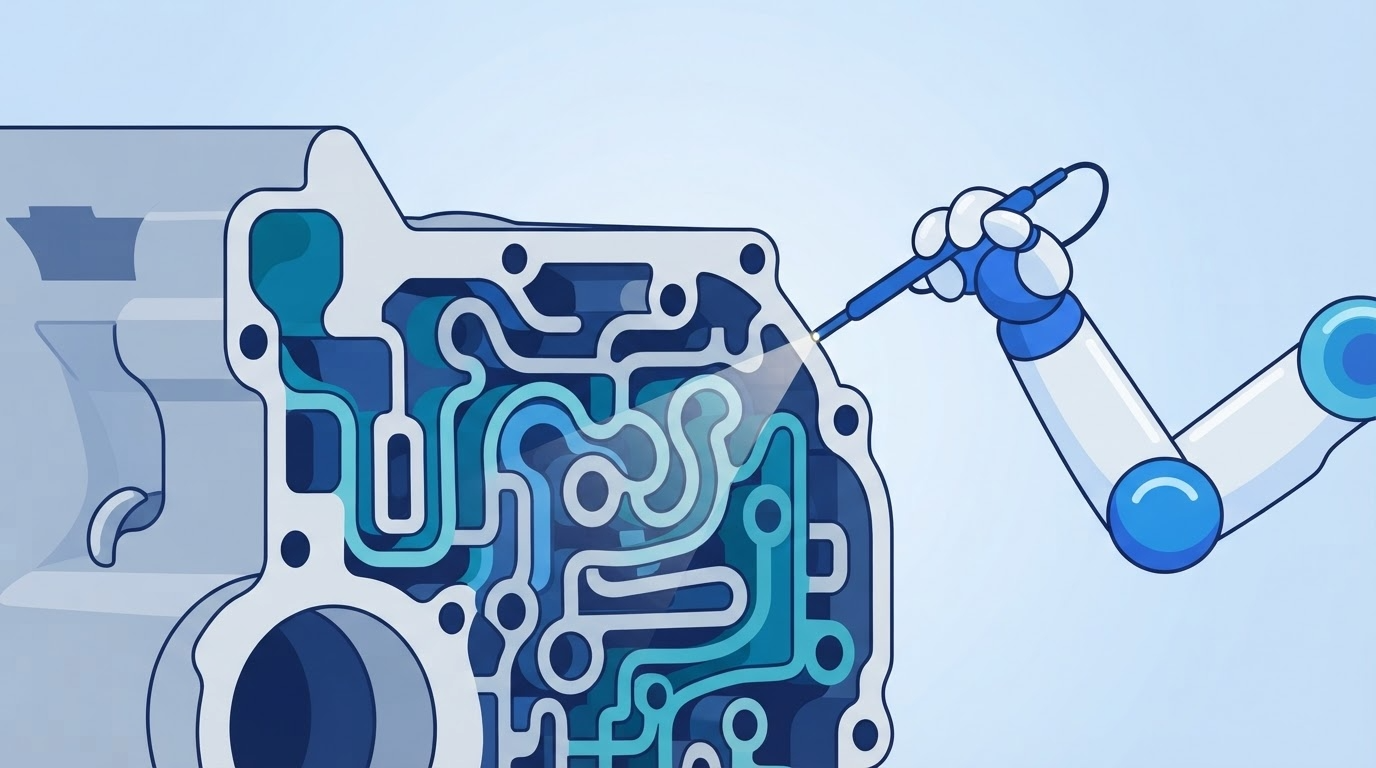
Hello! This is Linkgenesis 🙂
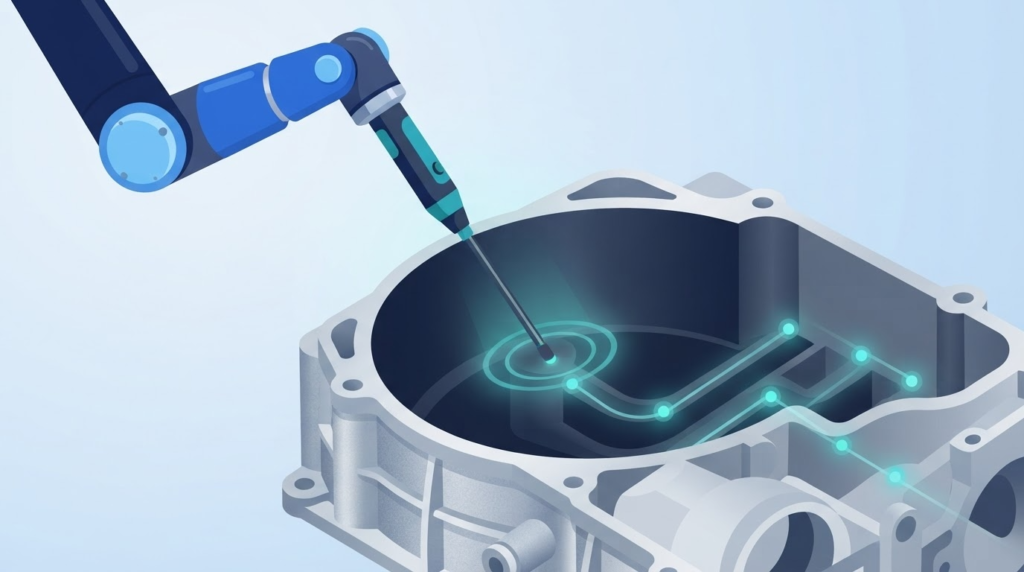
Think about an aluminum die-cast part — an engine case, a transmission housing.
Photographing the outside is easy;
a camera and a good light will do.
But what about the narrow oil passages, bores and holes on the inside?
No fixed camera reaches in there.
Today we’d like to introduce a machine built by our affiliate MSISROBOTICS that solves exactly that: an AI vision endoscope inspection robot. The name is literal — a robot picks up an endoscope and looks inside the part.
The Blind Spot Nobody Talks About
After die casting and machining, what’s left inside a part can include residual chips, unmachined surfaces, burrs, and blocked passages.
None of them are visible from the outside.
So plants have had two options.
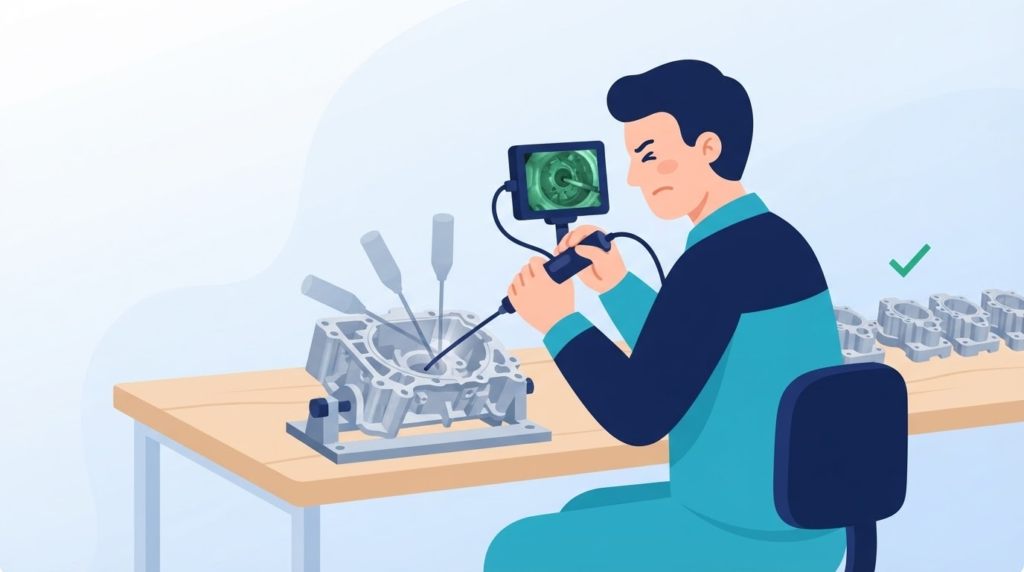
Either an operator holds a borescope and checks point after point by eye, or full inspection is quietly abandoned in favor of sampling.
A hand-held probe enters at a slightly different angle and depth every time, and the pass/fail call shifts from one operator to the next.
That’s why internal quality has been so hard to turn into data.
So, What Changes When a Robot Holds the Probe?
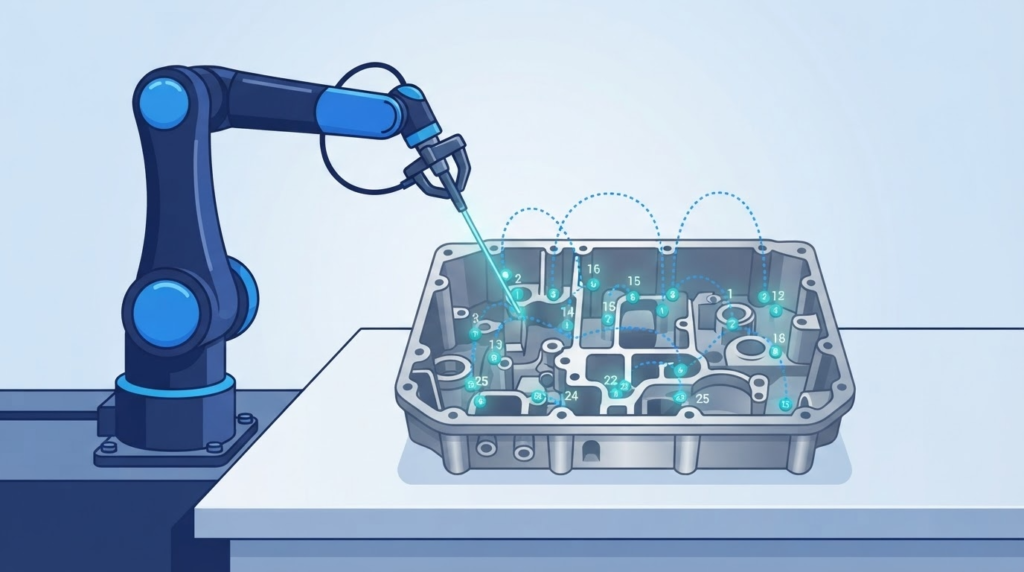
In the MSISROBOTICS system, a robot arm grips a rigid endoscope (borescope) probe and inserts it into the internal cavities of the part, one location after another.
In one deployment, 28 internal inspection points were defined on a single part, and the robot reproduced that insertion path on every unit.
Repeatable insertion means the same position, the same angle, the same conditions — and therefore comparable images, every single cycle. That’s the moment “looking at it” becomes measurable data.
The robot has been applied on an automotive engine-component line at one manufacturer (referred to as Company S) as part of a cell that also handles loading, assembly and stacking, and it was shown jointly with Rainbow Robotics at SIMTOS 2026.
Self-Learning AI — Trained Without a Single Defect Image
Here’s the obvious question: doesn’t an inspection AI need a large pile of defect photos?
Internal defects are rare by nature, which is precisely why so many vision projects stall before they start.
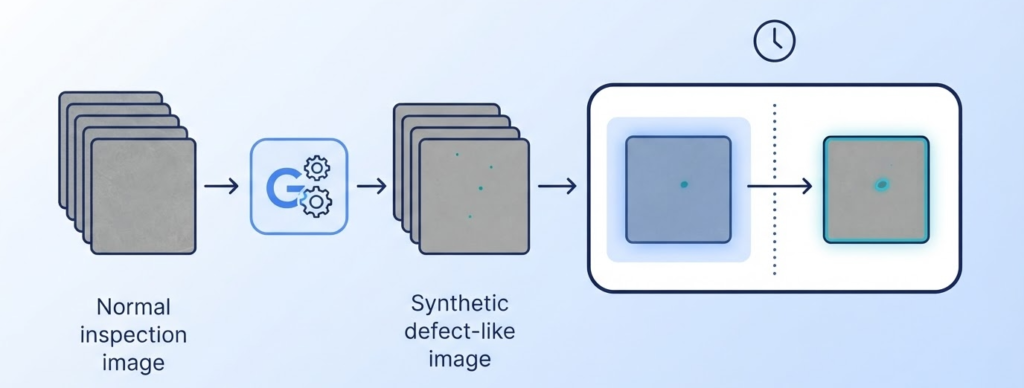
MSISROBOTICS approaches this with a combination of unsupervised and self-supervised learning. The model trains on normal images only, then automatically generates defect-like images from those normal images and learns from them on its own.
Their in-house TASAD model (Two-stage coarse-to-fine image anomaly segmentation and detection) uses a two-stage structure — CAS (coarse) locates the suspicious region, FAS (fine) segments it precisely.
Per their July 2026 materials, the result is zero defect-image collection, zero manual labeling, 20 minutes of self-training, and 99.8% defect detection accuracy.
Why This Matters Right Now
EV lightweighting keeps pushing more structural aluminum castings into vehicles, and with them a sharper focus on internal soundness — porosity, shrinkage, cold shuts and the like.
The revised IATF 16949 automotive quality standard is expected in late 2026 or early 2027, tightening expectations around quality and supply-chain risk management.

At the same time, the enabling technology has matured. The International Federation of Robotics reported in April 2026 that Korea leads the world in robot density at 1,220 robots per 10,000 employees, against a global average of 132. The machine vision market is projected to grow from about USD 13.6 billion in 2026 to USD 26.9 billion by 2034. Robotics and vision each grew up separately; the interesting work now is in combining them to see places people never could.
Wrapping Up
Put simply, the AI vision endoscope inspection robot does two things: the robot makes the probe path repeatable, and the self-learning AI makes the judgment consistent.
Together they make 100% quantitative inspection of a part’s interior practical, where it previously wasn’t.
Alongside this system, MSISROBOTICS offers
MSIS-MADS for equipment malfunction inspection,
MSIS-PADS for product appearance inspection and
MSIS-RADS for autonomous manufacturing robots, with field deployments including automotive ECU connector appearance inspection (six robots at Company H)
and automated screw-hole recognition, fastening and inspection across 30-plus high-mix, low-volume PCB types at Company E.
“Our part geometry is unusual.” “We have far too many inspection points.” “We don’t have a single defect image.” If any of that sounds familiar, just tell us.
In the AI era we’re able to take on SI work of any scale, from a single inspection cell to a full line.
Feel free to reach out for a review or a quote — no commitment needed.
Thank you for visiting our blog again today. Have a great day!

Leave a Reply