
Hello! This is Linkgenesis 🙂

Ask any equipment engineer about their worst moment on the job, and it usually isn’t the failure itself.
It’s the review afterward — scrolling back through the trace data and finding the warning that was sitting right there, hours before anything broke.
The data existed. Nobody was watching it in real time.
Today we’d like to talk about why equipment anomaly detection is genuinely hard, and introduce XFDM, our intelligent equipment anomaly detection solution.
The Problem Isn’t Too Little Data. It’s Too Much.

There’s a common assumption that anomaly detection fails because of missing data. In practice, it’s usually the opposite.
According to a recent industry analysis, a single etch tool can generate 10 to 50 GB of data per day. In a fab running 200 machines, raw data reaches petabyte scale within a single month. Any plan that begins with “we’ll ship all of it to a central server and analyze it there” is carrying a heavy load before it starts.
This is why the industry has been shifting toward evaluating data at the equipment itself.
Filter at the edge, forward only what matters, and the network, the server, and the engineers all get to breathe.
So, How Do You Decide Something Is “Abnormal”?
Anomaly detection isn’t one technique — it’s a layered combination of judgment methods. Simple threshold checks against spec limits. SPC control-chart run rules. Drift detection for a mean that’s slowly wandering. Multivariate methods that catch what no single parameter reveals on its own.

The real bottleneck is who writes the rules. The person who understands the equipment best is the engineer on the floor — but asking that engineer to also design statistical models from scratch is where a lot of anomaly detection projects quietly stall.
The Direction of Travel
The momentum is real. A January 2026 report describes Korea’s Ministry of Trade, Industry and Energy targeting 500 AI factories, built on a base of some 30,000 existing smart factories. One company profiled in that report reported reaching an 85% equipment failure prediction rate.
International analysis points the same way.
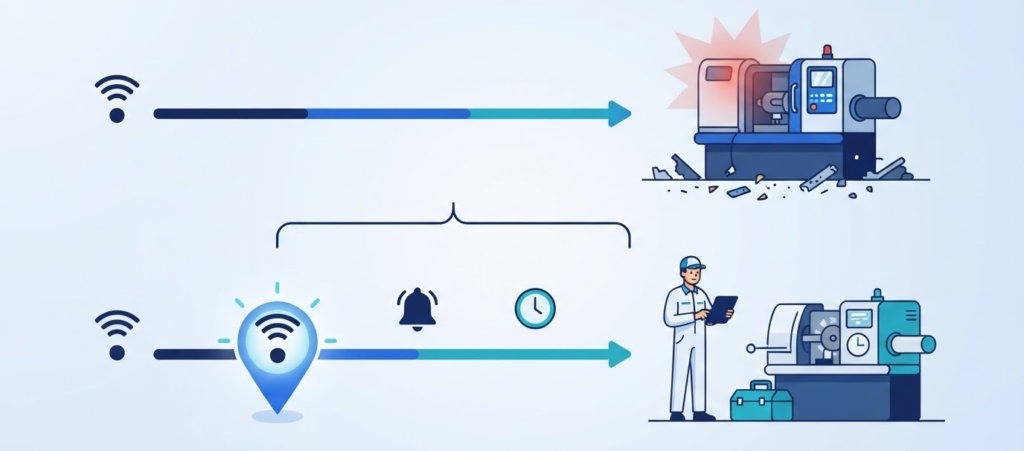
AI-driven predictive maintenance programs are targeting up to 30% downtime reduction, a 15% scrap-rate decrease, and 20 to 40 minutes of early warning.
Twenty minutes may not sound like much — but it’s often exactly the difference between an emergency stop and a repair moved into a planned maintenance window.
What XFDM Does
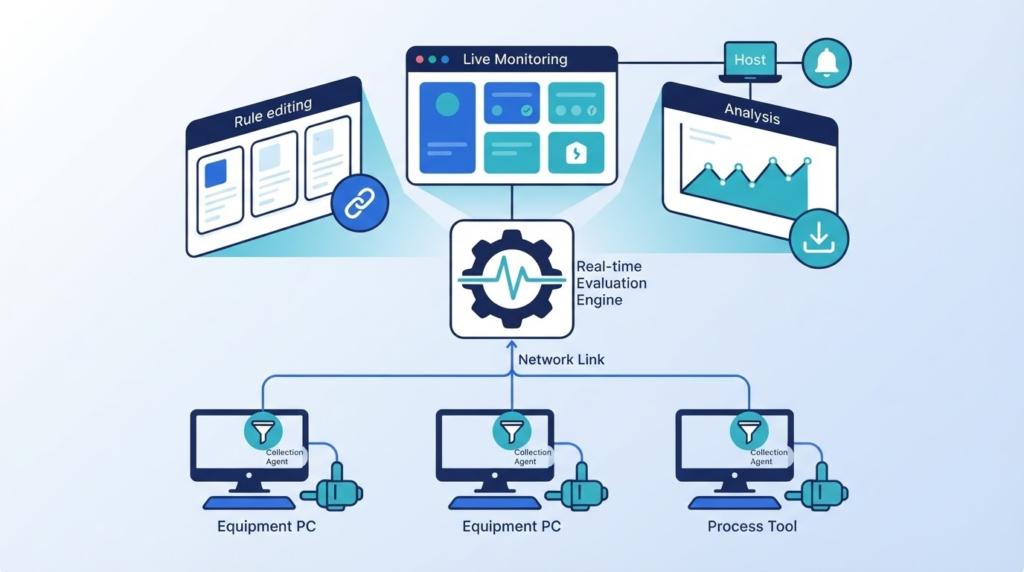
XFDM brings rule authoring, real-time evaluation, and analysis visualization together in one solution, built from three modules.
Rule Editor — register equipment status variables and design judgment rules. It ships with 8 rule templates plus user-defined ones, supports rule chaining to combine multiple conditions into a composite judgment, offers automatic rule generation that derives thresholds from measured data, and includes a preview so you can chart what a rule would have decided before you commit to it.
XFDM Engine — collects data from multiple tools and modules simultaneously and evaluates it in real time. Rules can be reloaded, started, and stopped at runtime without halting production. It supports both event-triggered and periodic evaluation, and saves each judgment as a snapshot while notifying on errors.
Analysis — query anomaly and trend history over any period, inspect per-rule snapshot charts, compare real-time trends across multiple status variables side by side, and export to CSV.
The eight built-in templates are Threshold Hold, EWMA Drift, CUSUM Shift, WE Run Rules, Volatility Rise, Spike Burst, Rate of Change, and Time Trend Slope, with expansion to 16 planned. Starting from a validated template and adjusting what you need beats designing a statistical model from nothing.
Collection is handled by a DAQ Agent on the equipment PC, so the first judgment happens at the tool itself; results flow over TCP/IP to the management tools and onward to the host, SMS, or messenger.
Because we’ve spent years on SECS/GEM communication and CIM implementation, we can design the whole chain in one piece — from reading a status variable off the tool to integrating with the systems above it.
Does “the data piles up but nobody watches it” or “we can’t face writing the rules” sound like your situation? We’d be glad to talk.
In the AI era, we’re able to take on SI work of any scale — a review covering a handful of tools, or a full line deployment.
Reach out anytime for a consultation or a quote.
Thank you for visiting our blog again today.
Have a great day!

Leave a Reply